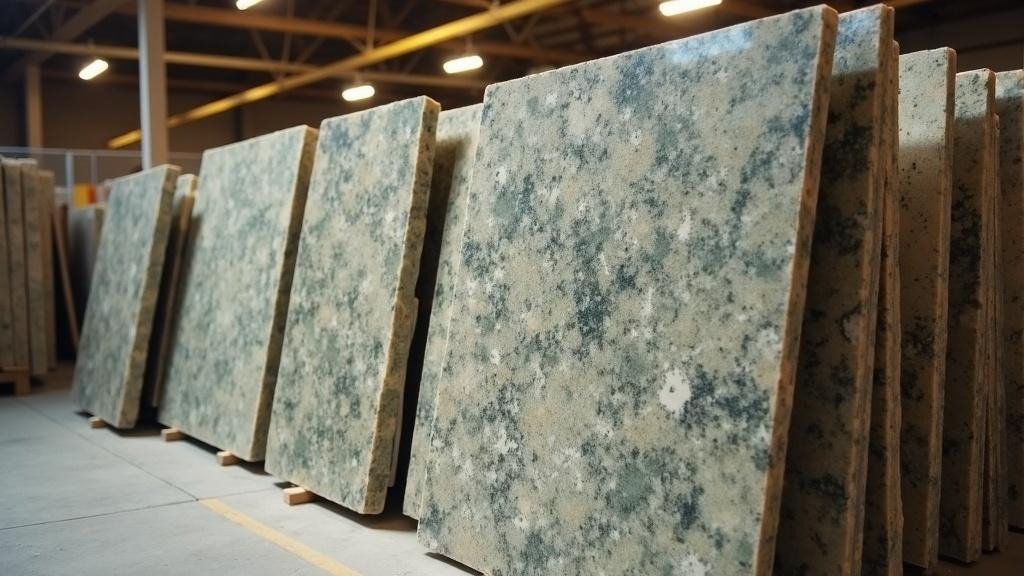
Most stone shops spend more time debating software than they do evaluating it. The category is crowded with tools built for generic manufacturing that got a “stone” label slapped on later. A few are genuinely purpose-built. Knowing the difference saves real money, because the wrong pick costs you in wasted slab material, not just subscription fees.
1. SlabWise
SlabWise is a cloud SaaS built specifically for custom stone fabricators, and the feature that sets it apart is AI-powered slab nesting that accounts for veining direction, edge rotation, and book-matching across multiple jobs at once. That alone addresses the single biggest source of avoidable material loss in a busy shop.
Beyond nesting, it handles DXF middleware (geometry validation, sink cutout matching, CNC file prep) and a quoting flow that runs from measurement import all the way to e-signature and Stripe payment collection. The Good/Better/Best tiered quote format is a deliberate sales tool, and SlabWise reports meaningfully higher close rates when shops use it. Entry point is a $1 seven-day trial, no commitment. Pro tier runs roughly $299/month for unlimited jobs.
Verdict: Best single-platform pick for CNC-running fabricators who want nesting, file prep, and quoting in one system.
2. Moraware CounterGo
CounterGo is Moraware‘s quoting and drawing tool, used by more than 2,600 shops. You draw the countertop, it calculates square footage and spits out a quote. It is fast, and it is the industry’s most familiar workflow for a reason. Pricing sits around $100 per user per month. It does not do CNC nesting or Stripe payment collection natively, but it pairs with Moraware’s other products.
Verdict: Reliable, widely supported, and easy to train new staff on. Not a full production system on its own.
3. Moraware Systemize
Systemize handles scheduling and job tracking once a quote becomes a real job. It runs $200 to $400 per month depending on modules, plus $50 per user after the first five seats. Shops that already use CounterGo often add Systemize to connect their sales and production calendars. The two tools share data, which cuts re-entry.
Verdict: Strong operational backbone for mid-size shops already in the Moraware ecosystem.
4. ActionFlow
ActionFlow is Moraware’s workflow automation layer. Think automated task triggers, status updates, and team notifications without manual follow-up. For shops processing high job volume, it reduces the communication overhead that typically falls on owners or shop managers.
Verdict: A productivity multiplier for busy operations, not a standalone quoting tool.
5. FabSuite
FabSuite covers shop management: inventory, scheduling, and job tracking in an integrated package. It targets fabricators who need a single system for material purchasing through production. The interface is less modern than newer cloud tools, but it handles the operational depth that lighter quoting apps skip entirely.
Verdict: Good fit for established shops that prioritize inventory control and production scheduling over sales-side features.
6. EasySTONE / EasyStoneShop
EasySTONE combines CAD/CAM with shop management, so you can take a slab from design through CNC toolpath in one platform. Entry pricing starts around $150 per month. It has a European heritage and is well-regarded for its CAD accuracy. The learning curve is steeper than quoting-only tools, which matters when you are onboarding new estimators.
Verdict: Worth serious consideration if your shop needs CAD design and machine output in the same system.
7. SigmaNEST
SigmaNEST is an advanced CNC nesting platform used across multiple industries, including stone. Its yield optimization algorithms are mature and well-tested. It is not a quoting tool. If your primary pain is material yield at the machine level and you already have a separate system for estimates and customer communication, SigmaNEST fits that gap.
Verdict: standout for CNC yield math, but you will need other tools around it for a complete shop workflow.
8. SlabWare (Moraware)
SlabWare (not to be confused with SlabWise) focuses on fabricator distribution and inventory management. It helps track slab inventory through the yard and into jobs. Useful for larger operations managing a significant stone inventory. Less relevant for smaller custom shops with modest slab stock.
Verdict: Solves a specific distribution and yard-management problem. Not a quoting or estimating tool.
9. QuickBooks (Adapted for Fabrication)
Thousands of stone shops still run estimates out of QuickBooks, using custom line items and templates. It works, technically. But it does not calculate square footage, it has no slab layout logic, and the back-and-forth with customers is entirely manual. It is also not free ($30 to $200 per month depending on tier).
Verdict: Acceptable for bookkeeping. A workaround for estimating, not a real solution.
10. Spreadsheet-Based Systems
Custom Excel or Google Sheets workflows are common, especially in shops under ten employees. They cost nothing and can be surprisingly sophisticated if someone built them carefully. The failure mode is version control: the wrong sheet gets sent, a formula breaks, and nobody catches it until a slab is cut wrong.
Verdict: Zero cost, meaningful risk. Fine for very low volume, fragile at scale.
11. Whiteboard and Manual Process
Still common. No software cost, no training time. Every shop starts here. The problem is that nothing is searchable, nothing is trackable, and growth pressure eventually breaks the system entirely.
Verdict: Where most shops start. Not where any shop should stay once monthly revenue exceeds a few thousand dollars.
How to Choose
Figure out where your shop is actually losing time or money, then buy for that problem specifically. Quoting slow? Start with a dedicated estimating tool. Wasting slab material? Nesting software pays for itself fast. Running a larger yard? Inventory management earns its fee differently than quoting software does.
See also: The Growing Popularity of Flat Roof Skylights in Modern UK Homes
Common Questions
Does countertop estimating software actually calculate square footage automatically, or do you still enter dimensions by hand?
It depends entirely on the tool. CounterGo and SlabWise both calculate square footage from drawn or imported dimensions, so manual entry is minimal once the layout is in. QuickBooks and spreadsheet setups require you to do the math yourself and type the result, which introduces error at exactly the wrong moment.
Can SlabWise and Moraware CounterGo run in the same shop without conflicting?
They can, though it is an unusual setup. CounterGo handles quoting and drawing, while SlabWise adds AI nesting and integrated payment collection. A shop that already has CounterGo but wants better slab yield and online payment might run both temporarily during a transition, but long-term most fabricators consolidate to one primary quoting platform.
What is the practical difference between SigmaNEST and SlabWise for slab nesting?
SigmaNEST is a dedicated, multi-industry CNC nesting engine with mature yield algorithms, sold as a standalone tool. SlabWise nesting is built into a broader fabrication platform that also handles quoting and job management. If nesting is your only problem, SigmaNEST goes deeper. If you want nesting plus estimating plus payment collection in one subscription, SlabWise is the more direct fit.
Is Moraware Systemize worth adding if a shop is already paying for CounterGo?
For shops running more than 20 to 30 jobs a month, yes. Systemize connects the sales calendar to the production schedule, which CounterGo alone does not do. The added cost runs $200 to $400 per month plus per-user fees, so smaller shops with lighter job volume may find the overhead hard to justify until they hit a scheduling bottleneck.
At what point does a spreadsheet-based estimating system genuinely become a liability?
Most fabricators hit the wall somewhere between 15 and 25 active jobs at once. Below that, a well-built Google Sheet can hold up. Above it, version control errors, broken formulas, and the time spent maintaining the sheet itself start costing more than a $100 to $300 monthly software subscription would. The real signal is the first time a slab gets cut from the wrong revision.
Sources
- Moraware public pricing page and product documentation (moraware.com)
- EasySTONE product specifications and pricing (easystone.com)
- SigmaNEST official product pages (sigmanest.com)
- FabSuite product overview (fabsuite.com)
- QuickBooks pricing tiers (quickbooks.intuit.com)